Stiction
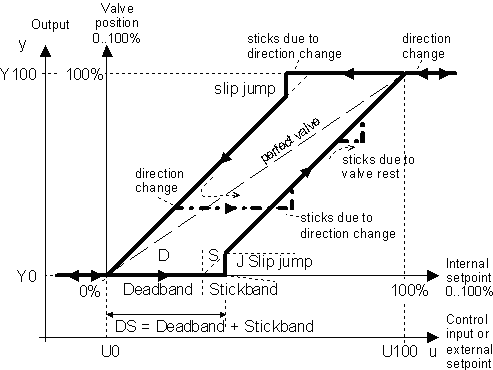
Valve stiction often imposes great problems on control loops since it can cause oscillations. The term stiction is the combination of the two words "stick" or "static" and "friction". It describes the effects that occur if the static friction exceeds the dynamic friction in valves, motors or other mechanical systems. When the valve is at rest and the control signal is increased the valve will not move until a certain force has been applied. But the resulting movement is not as uniform as in the case of a simple hysteresis characteristic. Since the valve sticks, the initial movement is a jump. Sticking occurs if the valve stops, moves very slowly or changes direction.
The stiction element in SimApp is not limited to valves. It acts as a common actuator element for various devices having stiction. It deals only with the effects of hysteresis and sticking. Other effects that are device dependent are achieved by subsequent elements or sub systems.
SimApp uses an empirical model described in a paper of S. L. Shah (Modelling Valve Stiction) that is not based on physics but is simple to implement and easy for industrial personnel to measure the required parameters.
In the model, stiction occurs if the sign of the slopes changes or remains zero (speed = 0) for two consecutive time intervals. To observe the speed of the valve the position is sampled in consecutive time intervals. The length of the interval equals the integration interval, specified in the time simulation properties dialog.
In practice, stiction is expressed as % of the span of the input signal or the valve travel. In the SimApp block we cannot explicitly specify the value "stiction". In reality however, deadband (<=3%), stickband (<=1% and slip jump (<=1%) are very small. Under these circumstances stickband and slip jump are almost equal (ca. 0.02% difference) and so both equal stiction. So, if you have a stiction value, use it for slip jump (if values are small).
For more information about valve stiction, please refer to papers and web pages of Shah, Ruel and others (keywords: valve, stiction, Shah, Ruel).
Parameters
-
DS [%], Deadband + Stickband
Hysteresis of the valve in % of the valve range (0..100). -
J [%], Slip jump
The jumpy movement of the valve in %, if the cumulative change of the input signal is greater than the stickband (0..100). -
U0
Input signal for 0% valve travel -
U100
signal for 100% valve travel -
Y0
Output signal for 0% valve travel (valve closed) -
Y100
Output signal for100% valve travel (valve fully opened)