Ideal PID Controller, Type 1
PID control structures are used if the steady-state and the transient performance of the control system are not to adequate.
The first form of the ideal PID controller corresponds to the parallel connection of a unit-gain, an integrator and an ideal differentiator followed by a saturation element. As parameters, the gain, the rate time and the reset time are used. In addition the falling edge of the differentiator can be delayed by TD.
The initial value of the output signal is determined by the input value, the gain and the integrator's initial value Y0I: Y0:= U0 * K(1 + Y0I);
The output signal can be limited to the range Ymin ... Ymax by two selectable anti-windup measures.
Windup appears because the integral term increases too much during saturation.
Thus, during saturation the increase should be slowed down.
Anti-Windup-Hold
The integration is stopped when the saturation's input signal leaves the valid range (the upper or lower limit of the saturation). As soon as the signal is reduced, the integrator is released.
Anti-Windup-Reset
If the saturation's input signal exceeds the limit, the integrator's output signal is reduced so that the sum of integrator, differentiator and unit-gain equals exactly the limit (Ymax or Ymin).
Functions
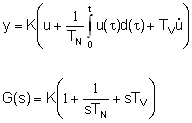
TN > TV
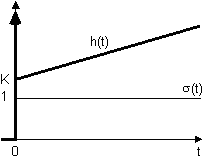
Step response
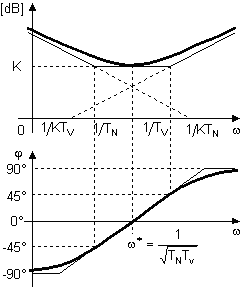
Magnitude and phase response
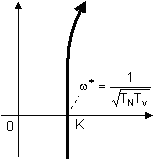
Polar plot