Dead Time (PTt)
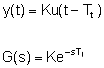
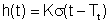
The dead time (delay) element delays the input signal by the dead time Tt, but does not change the signal shape.
Functions
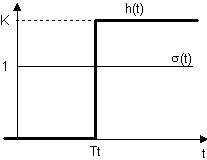
Step Response
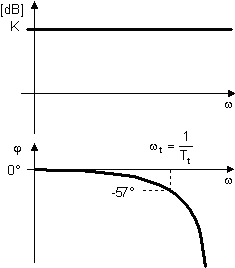
Magnitude and phase response
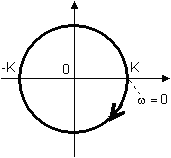
Polar plot
Padé equivalents
The transfer function of the dead time element has neither a numerator polynomial nor a denominator polynomial. Since poles and zeros are not defined, eigenvalues do not exist and SimApp will not try to calculate them.
To eliminate this disadvantage the dead time element must be described by state variables. But since the dead time element cannot be described by a finite number of state variables, we must use an approximation.
SimApp offers two approximations developed by H.E. Padé [1].
Padé allpass
The rational transfer function of the Padé allpass function is
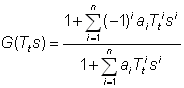 wherei
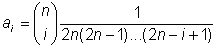 ; i=1..n
The allpass shows good results in the frequency domain. The magnitude characteristic is exact and the phase characteristic matches that of the pure time delay up to a frequency of 10 w t . But in the time domain the step response is rather unruly - the initial value depends on the order n being equal to 1 or –1 (although it should be 0) followed by an intensive oscillation.
By means of the second approximation you can obtain better results in the time domain.
Padé approximation
The rational transfer function of the Padé approximation is
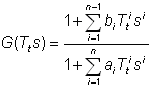 where
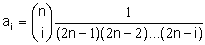

The Padé approximation does not have the exact allpass characteristic of the Padé allpass. However, the step response is much better. The initial value now is zero.
Which method to use?
If you perform time simulations, you should use the ideal dead time element without any approximation. The response is absolutely exact without any distortions or over- and undershoots. But the need of buffer memory can be rather high for long dead times. If your computer is short of main memory, an approximation might be indispensable. If the dead time element is close to the input of the system where effective steps and spikes can occur, you should use the Padé approximation because of its better time response.
For frequency simulations, the ideal dead time element yields exact values for the magnitude and the phase curve. For the calculation of the eigenvalues, it is replaced by a unit-gain element without any phase lag. Therefore, the influence of the delay on the eigenvaluesis not computed. For valid eigenvalues you should use a Padé approximation. The Padé allpass shows a good frequency response. Note that the poles and zeros of the Padé allpass affect the whole system and influence the number and magnitudes of eigenvalues.