Derivative Element
Pure differential behavior cannot exist in a real (causal) system and cannot be realized by computers. This derivative element is the best approach to the ideal differentiator. For time simulations, the approach depends on the integration step size and for frequency simulations, it depends on stop frequency.
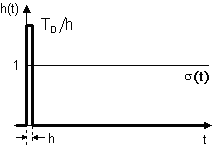
An ideal differentiator responds by a infinitely high pulse that lasts an infinitely short time interval only. In simulations however, the pulse height is limited to TD/h and the pulse length to h where h is the Integration step size. The shorter h the better is the approximation to the ideal behavior. As an ideal behavior cannot occur in real systems, the approximation in SimApp is not a disadvantage.
Functions

Step response

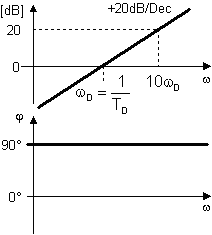
Magnitude and phase response
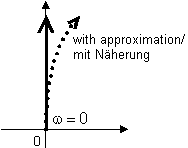
Polar plot
Implementation notes:
As a pure differentiator can not be implemented by programming, SimApp uses a real differentiator whose coefficients are set in such a way that they approximate the ideal behavior.
The transfer function of a more realistic differentiator includes a lag:
 . Ideally, T is 0.
For time simulations: T = h (integration step size)
For frequency simulations:
 where

= simulation stop frequency (set by user)
or
 ;
depending on which value is smaller.