Sampler
The sampler element samples the input signal at sampling points kT (T = sample period) and supplies a pulse train at its output.
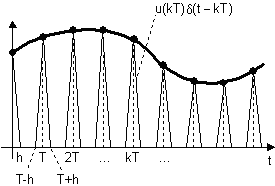
Time domain
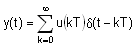

Frequency domain
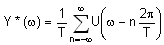
where U(ω) is the spectrum of the continuous input signal.
The spectrum of an ideally sampled signal u(t) is equal to original time continuous signal weighted by the sampling period T and periodically repeated by the sampling frequency 2π/T
The description of a discrete time signal as a triangular pulse train does not fully correspond to reality. After sampling, the signal is only defined at sampled points kT. All the following discrete time elements use only these values. Therefore, the shape of the pulses is not important as it is not considered in the following process. Therefore, it is not proper to supply the output signal of a sampler to a time continuous element. The resulting signal would not correspond to reality.
Behind a sampler only discrete time elements are allowed which consider the signal at sample points only and do not care about the values between.
To supply a sampled signal to a time continuous system, it must be held between the sampled points by a hold element. But most real and discrete time elements already fulfill this condition as they hold the value of the last sampled point until the new value is applied. That is also true for all discrete time elements in SimApp during a time simulation. However, in frequency simulations the sample and the hold elements must exist in pairs. (See introduction to discrete time elements.)